
One extra step in your hiring process slashes time to hire, increases the likelihood you hire a candidate with the right skillset, and cuts hiring costs: sales assessments.
Key Takeaways
- Sales assessments reduce hiring bias by screening candidates before resumes and interviews influence decisions.
- They uncover sales competencies that don’t show up on resumes, including coachability, consultative selling, and hunting.
- Assessments cut time-to-hire by quickly narrowing the candidate pool without sacrificing quality.
- A repeatable process improves hiring consistency and removes guesswork across the team.
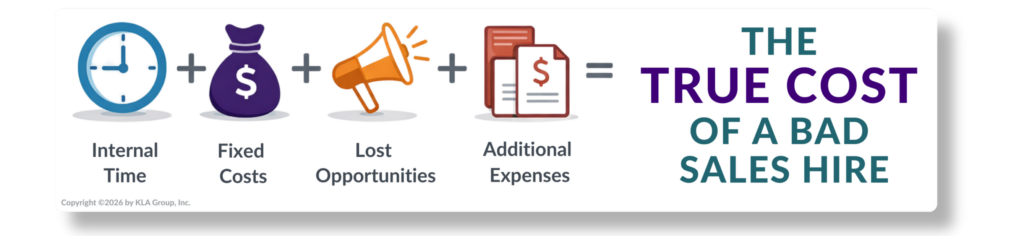
- The true cost of a bad hire includes internal time, fixed costs, lost opportunities, and additional expenses.
Why Should I Use Assessments to Hire Salespeople?
KLA Group sales coaches and trainers consult clients to introduce assessments as early in their hiring process as possible, because assessments:
- Remove hiring bias
- Eliminate candidates who lack the skills required for your position
- Create a repeatable, streamlined process
When there was a sales opening on our team, we sent an assessment before undertaking extensive resume reviews or interviews.
This prevented us from falling for a candidate who looked good on paper but, when put to the test, lacked the skills the position required. Ultimately, we hired a salesperson who generated three opportunities within their first five weeks and closed their first sale on their 46th day with the company.
5 Ways Assessments Instantly Improve Your Sales Hiring Process
1. Effectively screen candidates without bias
Bias can occur at any stage of the review process. You’re looking over resumes and see someone shares your alma mater, or a remote candidate lives in a place you love visiting. Your positive associations transfer to the candidate and can cause you to overlook weaknesses or red flags.
Assessing candidates before anyone looks at their background prevents arbitrary connections trumping potential and skill.
2. Identify skills that don’t show up on a resume
How do you identify sales skills that don’t show up on a resume? This is one of the trickiest hiring questions to answer.
You may think you can spot personality factors like resilience, drive, or coachability, but like we said above, bias easily creeps in during resume reviews and interviews. On top of that, people can claim whatever they want in an application. How do you know it’s true?
With assessments, you don’t rely on resume bullet points or standard hiring questions to determine a person’s capabilities. The assessment shows you if the applicant has the skills you’re looking for.
3. Reduce time to hire and expenses
Applications flood your inbox the day you advertise an opening and keep coming until you close the posting. Keeping up with the daily deluge takes hours.
Assessments quickly reduce the volume without sacrificing quality candidates. You spend a few hours a week, not multiple hours per day, because you only look at resumes and respond to pre-qualified applicants. The assessment KLA Group used when hiring a salesperson for our team removed 95 candidates from the process.
4. Establish a fair, objective, repeatable sales hiring process
KLA Group coaches set clients up for consistent sales hiring success by teaching a repeatable process with assessments baked in:
- Develop an on-point and compelling job description
- Assess and interview
- ID realistic performance expectations
- Establish a comprehensive onboarding plan
- Lead
Standardizing hiring removes guesswork. No one wonders “What do we do first?” because everything is documented, including how and when to use the assessment.
5. Mitigate the risk of hiring the wrong person
Ballpark figures exist that estimate the answer to: What is the true cost of a bad sales hire?
KLA Group recommends you use the formula below to find the cost of a bad sales hire at your organization:
Internal time + fixed costs + lost opportunities + additional expenses = the true cost of a bad sales hire.
1. Calculate how much time it will take each person involved to:
- Write a job description and job ad
- Select where you’ll place the ad
- Post and manage the job listing
- Review resumes
- Contact candidates
- Schedule and conduct interviews
- Run background checks
- Call references
- Onboard and train your new hire
2. Multiply the time spent by the hourly rates or burdened cost for each person involved and add these calculations together.
3. Itemize fixed costs, like posting the ad and salary and benefits for your new employee.
4. List out other additional costs like:
- Lost opportunities because the salesperson does not sell the forecasted amount in the time period expected
- Other additional expenses, like training or professional development programs to help them develop missing skills required for the role
5. What is the true cost of a bad sales hire?
Add steps 2, 3, and 4 to calculate what a bad sales hire costs your organization.
Which Sales Assessment Tests Do You Recommend for Hiring?
KLA Group partners with Objective Management Group (OMG) because their assessments are comprehensive and cost effective. Since our partnership began, we’ve assessed over 2 million sales professionals and/or roles.
OMG uses flat rate pricing, which lets you evaluate as many people as necessary.
For our last sales hire, we did not pay 67 times for the 67 people we evaluated. We paid one, fixed cost and could have assessed 167 people (or more) if we wanted.
How Do You Use a Sales Assessment When Hiring Salespeople?
KLA Group recommends these five best practices for using assessments in your sales hiring process:
- Choose a rigorous assessment, like Objective Management Group
- Identify the criteria that matter most for your role
- Send the assessment early in the process
- Remove unqualified candidates
- Follow-up quickly with top choices
1. Choose Rigorous Assessments for Sales Candidates
You do not want an assessment that is too easy, or too hard. It’s a red flag if the data show everyone passes or everyone fails.
You want to see a range of responses in aggregated data, like what you observe in this data from OMG from 2025 sales candidates based in North America. It shows what percentage of salespeople received a “strong” score for the competencies listed below:
- Handles rejection: 96%
- Relationship building 74%
- Reaching Decision-Makers: 41%
- Social selling 15%
- Consultative selling 25%
- Hunting 65%
Handles rejection is high, and that makes sense. Most salespeople expect to frequently hear “no.”
Others, like reaching decision makers, require a continual willingness to adapt and learn new skills. Not everyone is willing or able to do this, and you see that reflected in the scores.
Now that you know why an assessment is an integral part of your hiring process, let’s cover how to use one to screen candidates.
2. Identify the Criteria That Matter Most for Your Role
Consider the dataset above again. If reaching decision makers is a key competency, the hiring team knows they won’t have to review around 60% of candidates. This saves time and keeps the focus on candidates who have demonstrated that capacity.
Those scores aren’t the only skills OMG evaluates.
Other key competencies include:
- Will to Sell
- Sales DNA
- Hunting
- Selling Value
- Consultative Selling
- Figure-it-Out Factor
- Coachability
Familiarize yourself with your assessment’s criteria before you send it out.
Know which scores matter most for your organization and role. Determine a threshold for who you will and won’t consider depending on their results.
When KLA Group used the OMG assessment, we knew we needed someone prepared to work consultatively with clients, have a strong will to sell, a high figure-it-out factor, and be coachable to continually adapt to our clients’ varied needs. We used this to reduce candidates who did not meet our expectations in this competency.
3. Send the Assessment as Early in the Process as Possible
KLA Group’s sales experts coach clients to use assessments early in the application process. You want candidates to complete it before you interview them because you do not want to fall in love with a candidate who is an exceptional interviewee but lacks the sales skills your position requires.
4. Remove Unqualified Candidates
The assessment tool should score candidates for you. OMG assessments show who is Recommended, Worthy of Consideration, and Not Recommended in your dashboard. This makes it quick to spot the candidates you want to consider. If you want to see more about an individual candidate, you can look in their individual report.
KLA Group advises only moving forward candidates who are marked “Recommended” in OMG. In rare cases, you may advance someone who is “Worthy of Consideration” and has high scores in the competencies most important to the role.
5. Follow-up Quickly with Top Choices
You do not hold all the cards when hiring. Your top choice is likely the top choice for another job, too. If you wait too long to reach out, they’ll move on to another opportunity.
Remember: Assessments Do Not Guarantee Success
Objective evaluations lead you to the most talented candidate who meets your expectations at the role and company level. They cannot reveal if you have the right infrastructure in place to support a rep. You can hire the best salesperson in the world and they will fail if your organization is not prepared.
Are You Ready to Hire?
Watch the Replay of Why You Keep Hiring Sales Reps Who Fail to find out.

Sales Assessments Are One of the Fastest Ways to Improve Sales Hiring.
When you send a sales assessment early in the process, you reduce bias, eliminate unqualified candidates before interviews, and speed up time to hire while lowering overall hiring costs. The result is a more consistent, repeatable hiring process that increases your odds of hiring a salesperson with the skills your role requires.
Don’t Waste Time on the Wrong Sales Candidates
KLA Group helps you screen faster, hire smarter, and build a repeatable sales hiring process using proven sales assessments and structured interviews.
Book your no-obligation consultation and start now.
Frequently Asked Questions
What’s the difference between a personality test and a sales assessment? Do they measure the same thing?
Personality tests (Myers-Briggs, DISC assessments, etc.) may help you understand how someone prefers to communicate or work, but they don’t measure whether a candidate can succeed in a specific sales role.
A sales assessment is built to evaluate sales performance indicators, not just traits. The OMG assessment KLA Group uses measures sales-specific success criteria, including:
- Will to Sell
- Sales DNA
- Hunting
- Consultative Selling
- Relationship Building
- Reaching Decision-Makers
- Coachability
- Selling Value
- Figure-It-Out Factor
Personality tools can be helpful context, but a sales assessment gives you clearer insight into whether the candidate has the competencies to execute the job.
How do I know I’m ready to hire a salesperson?
You’re ready to hire when your business can support a salesperson with enough structure to win. Before you post the job, confirm you have:
- A clear sales role (hunter vs. farmer vs. hybrid)
- A defined target market and offer
- A simple lead flow or prospecting plan
- A realistic ramp timeline and performance expectations
- A basic onboarding plan and someone to coach and manage the rep
If those pieces aren’t in place yet, even a strong salesperson can struggle because they’re forced to build the entire system while trying to hit a number.
Why do my sales hires keep failing?
Most sales hires fail for one of three reasons:
- The role isn’t clearly defined (wrong expectations, wrong sales motion, unclear priorities)
- The candidate wasn’t actually qualified (great interview, weak sales competencies)
- The company isn’t set up to support success (no onboarding plan, no coaching, inconsistent lead flow)
Should I test every sales applicant before the interview, or only finalists?
KLA Group recommends you test candidates before interviews, not after.
What are the biggest challenges in hiring top-performing salespeople?
KLA Group has found the biggest challenges when hiring top-performing salespeople are:
- Strong candidates have options, so delays cost you
- Resumes hide the truth (tenure and titles don’t equal skill)
- Interview performance can be misleading
- Hiring teams fall into bias without realizing it
- Companies hire for “likeability” instead of capability
- Sales roles vary widely, so “good salesperson” changes from one organization to another
Sales assessments solve the “looks great on paper” problem and help you hire based on role fit and competency.
What measurable impact do assessments have on hiring results?
Sales assessments improve hiring outcomes because they reduce wasted time and improve candidate quality. The measurable impact typically includes:
- Reduced time-to-hire by eliminating weak candidates early
- Lower hiring costs by cutting down interviews and admin work
- Improved retention by hiring people who fit the role and can succeed
- More consistent performance because hiring becomes repeatable and objective
Assessments don’t guarantee success, but they dramatically improve your odds of hiring the right person and avoiding expensive hiring mistakes.
About Kendra Lee
Revenue generator and founder of KLA Group, Kendra Lee helps small and mid-sized companies grow revenue by getting seen, getting heard, and getting traction with sales, marketing, and AI strategies that cut through the noise. She’s the author of The Sales Magnet with her third book, From Chaos To Revenue, coming 2026.
Read More Related Articles