
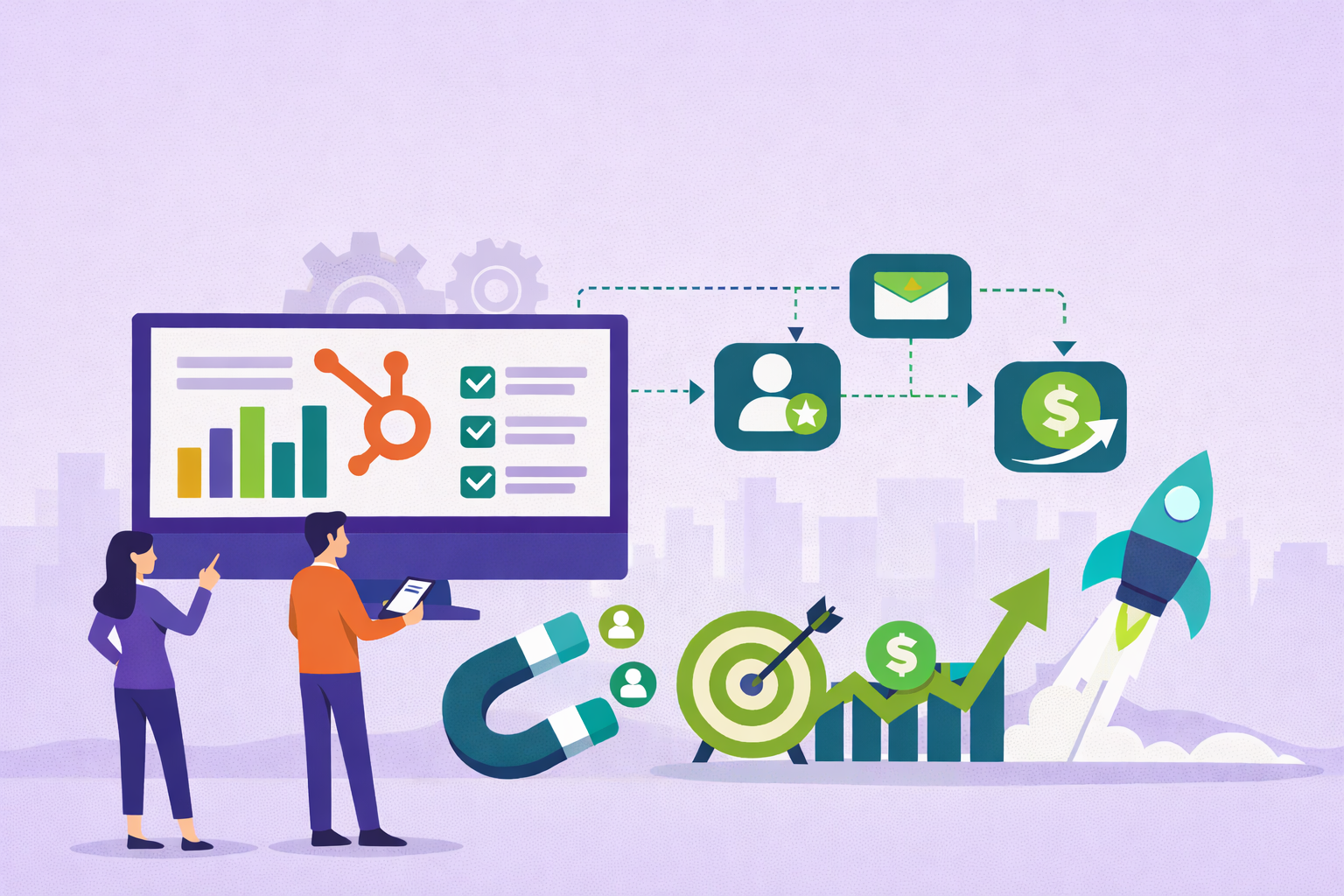
Key Takeaways
- HubSpot marketing automation eliminates inconsistent follow-up that slows revenue.
- Automation inside HubSpot CRM connects marketing engagement directly to sales execution.
- Lead scoring helps sales focus on real buying signals instead of guessing.
- Workflow triggers prevent pipeline gaps before they damage results.
- HubSpot AI strengthens automation by reducing delay and improving visibility.
How HubSpot Marketing Automation Helps You Achieve Sales Goals Faster
HubSpot marketing automation helps you achieve sales goals faster by structuring follow-up, exposing engagement, and reinforcing accountability inside HubSpot CRM.
Most companies don’t miss their sales goals because they lack leads.
They miss them because execution breaks down between marketing activity and sales action.
Marketing generates interest.
Prospects engage.
Sales is busy.
But no system connects engagement to disciplined follow-up at the right time.
HubSpot marketing automation fixes that when it’s configured correctly.
At KLA Group, we implement automation to increase opportunity movement, not just email volume. When engagement triggers action automatically, productivity improves.
Here’s how to use HubSpot marketing automation the right way.
Why You Need More Than Sales Activity
You need more than activity because activity alone doesn’t create measurable opportunity.
When revenue slows, many teams increase outreach. More campaigns. More calls. More emails.
But without structure inside HubSpot CRM:
Leads cool off before sales reaches out.
Sales contacts prospects without context.
Marketing continues nurturing prospects already in active deals.
Leadership cannot see where momentum breaks down.
This isn’t a volume problem.
It’s a visibility and discipline problem.
HubSpot marketing automation introduces structure so engagement triggers action automatically, not occasionally.
How HubSpot Turns Marketing Activity Into Sales Momentum
Here’s how HubSpot helps you hit your sales goals faster:
Use marketing automation workflows to score engagement, trigger tasks, update lifecycle stages, and connect campaign performance directly to pipeline visibility inside HubSpot CRM.
With HubSpot Marketing Hub integrated into HubSpot CRM, you can:
- See who is engaging in real time
- Trigger action based on buying signals
- Pause or accelerate communication automatically
- Measure campaign influence on opportunity creation
At KLA Group, we configure HubSpot so marketing and sales operate inside one connected revenue system.
Now let’s break down five practical applications.
HubSpot Marketing Automation: Your Sales Process in Motion
Your sales goal is your destination and HubSpot marketing automation is the structure that keeps movement consistent.
High-performing teams use automation not to “do more marketing,” but to remove follow-up gaps and improve sales productivity.
Here’s how.
1. How Does HubSpot Automate Lead Nurturing to Improve Conversion?
HubSpot marketing automation nurtures leads automatically using behavior-based workflows inside HubSpot CRM.
Without automation, follow-up depends on memory. That creates inconsistency.
With HubSpot workflows, you can:
- Send targeted email sequences after form submissions
- Deliver industry-relevant examples automatically
- Pause marketing emails when a deal becomes active
- Re-engage leads when activity drops
- Move contacts from MQL to SQL based on engagement thresholds
Sales reps can see full engagement history inside HubSpot CRM before making a call.
This changes the quality of the conversation.
Instead of generic outreach, sales references actual behavior.
Try it with a free HubSpot CRM account »
2. How Can HubSpot Lead Scoring Help Sales Focus on the Right Prospects?
HubSpot lead scoring ranks contacts based on engagement and buying behavior so sales focuses on real opportunity not surface activity.
Sales teams often chase the loudest leads.
But loud does not equal ready.
Without structured scoring inside HubSpot CRM:
- Sales wastes time on curiosity instead of intent.
- High-value prospects wait too long.
- Managers lack visibility into priority.
HubSpot Marketing Hub allows you to score contacts based on:
- Repeat website visits
- Pricing page engagement
- Email interaction patterns
- Webinar attendance
- Role or company size
When a threshold is reached, HubSpot automatically:
- Updates lifecycle stage
- Creates a task
- Notifies the assigned rep
- Moves the contact into a higher-touch workflow
- Automation doesn’t replace discipline. It makes discipline measurable.
At KLA Group, we build scoring models around deal progression, not vanity engagement.
Focus improves close rate.
Close rate improves revenue.
3. How Does HubSpot Marketing Automation Reduce Pipeline Gaps?
HubSpot automation workflows reduce pipeline gaps by replacing reliance on memory with structured triggers.
- Pipeline leaks happen quietly.
- A proposal sits.
- A follow-up gets delayed.
- A deal lingers in stage too long.
Without automation inside HubSpot CRM:
Managers discover stalled deals too late.
Forecasts become optimistic instead of accurate.
HubSpot Sales Hub and HubSpot CRM allow you to:
- Trigger tasks when no activity occurs within defined timeframes
- Send automated follow-up after proposals
- Alert managers when engagement drops
- Launch re-engagement workflows
Automation doesn’t replace discipline. It exposes where discipline breaks down.

4. How Can HubSpot Campaign Automation Connect Marketing to Revenue?
HubSpot marketing automation connects campaigns directly to opportunity creation using attribution reporting inside HubSpot CRM.
Many executives ask:
“What is actually creating revenue?”
HubSpot Campaigns and Attribution Reports show:
- Which campaigns generated MQLs
- Which MQLs became SQLs
- Which SQLs converted into deals
- Total revenue influenced
When HubSpot Marketing Hub and HubSpot CRM operate together, both marketing and sales see the full revenue path.
Visibility creates confidence.
Confidence drives consistent execution.
At KLA Group, we use HubSpot reporting to identify where opportunity creation is working and where adjustments are needed.
5. Build an Automated “Revenue Momentum” System
Your executive team does not need more dashboards.
They need clarity.
Inside HubSpot CRM, build one automation dashboard that includes:
- MQL to SQL conversion
- Lead score distribution
- Workflow enrollment and drop-off
- Campaign influence on pipeline
- Deal velocity and time-in-stage
If you cannot see where engagement turns into opportunity, or where it stops, you cannot manage growth.
HubSpot marketing automation gives you that visibility.
At KLA Group, we call this connecting automation to accountability.
Clarity leads to confidence.
Confidence leads to consistent execution.
Pro Tip: Use HubSpot AI to Strengthen Automation
HubSpot AI strengthens marketing automation by reducing delay between engagement and response.
Use HubSpot AI tools to:
- Draft follow-up emails
- Summarize engagement history
- Recommend next actions
- Analyze workflow performance trends
- Flag at-risk deals
HubSpot AI improves speed.
Speed improves productivity.
Used correctly, AI supports execution across marketing and sales inside HubSpot CRM.
Why Should You Review Automation Weekly?
Here’s what happens when you review automation inside HubSpot weekly:
Marketing sees which workflows drive opportunity creation.
Sales focuses on high-intent prospects.
Managers identify stalled momentum early.
Accountability improves without micromanagement.
You scale engagement without adding headcount.
Automation without review becomes invisible.
Review turns automation into performance.
Example: What Structured Automation Looks Like
Imagine a B2B company generating steady inbound leads.
Marketing captures engagement inside HubSpot CRM. Sales receives alerts.
Without structured automation:
- Some leads receive immediate outreach.
- Others wait.
- Engagement drops.
- Momentum slows.
When HubSpot marketing automation is configured correctly:
- Lead scoring updates automatically.
- Tasks trigger based on buying signals.
- Re-engagement emails deploy when activity slows.
- Managers see workflow performance inside dashboards.
HubSpot will not fix a broken process. It will expose one. And when you can see what’s creating opportunity, and what isn’t, you can make better decisions faster.
Ready to Achieve Your Sales Goals Faster?
HubSpot isn’t just a marketing automation tool.
It’s part of your revenue generating system.
When automation is structured correctly inside HubSpot CRM, you can:
- See what’s actually creating opportunity.
- Identify where follow-up breaks down.
- Improve sales productivity without adding headcount.
- Forecast with greater confidence.
Automation doesn’t replace discipline.
It makes discipline visible.
Use this article as a guide and strengthen your HubSpot marketing automation so engagement turns into measurable movement through your pipeline.
If you aren’t using HubSpot CRM, get started free today and begin building structured automation that supports your sales process.
Create your free HubSpot account here »
If you want help configuring HubSpot marketing automation from defining your workflows to connecting them to sales execution and reporting, contact KLA Group. We’ll help you build a system that drives consistent growth.
FAQs: HubSpot Marketing Automation & Sales Performance
Q: What’s the best automation to build first in HubSpot CRM?
A: Start with a behavior-based lead nurture workflow connected to lifecycle updates and task creation inside HubSpot CRM. At KLA Group, this is often the first automation we implement because it improves follow-up consistency immediately.
Q: How can HubSpot marketing automation help my team achieve sales goals faster?
A: HubSpot marketing automation turns engagement into action by scoring leads, triggering follow-up tasks, and connecting campaign activity directly to pipeline visibility inside HubSpot CRM.
Q: Is lead scoring available in all HubSpot plans?
A: Basic tools are available in HubSpot CRM, while advanced lead scoring and workflow automation are part of HubSpot Marketing Hub Professional and Enterprise tiers.
Q: Can I connect marketing campaigns to sales reporting in HubSpot?
A: Yes. HubSpot Campaigns and Attribution Reports connect marketing activity directly to opportunity creation inside HubSpot CRM.
Q: How does AI support HubSpot marketing automation?
A: HubSpot AI can draft communication, recommend next steps, summarize engagement history, and identify at-risk deals to improve timing and execution.
Q: How often should automation be reviewed?
A: Review key HubSpot dashboards and automation workflows weekly during sales meetings to maintain visibility and accountability.
Q: Can KLA Group help implement HubSpot marketing automation?
A: Yes. KLA Group works with B2B companies to configure HubSpot marketing automation, align it with sales execution, and integrate it into a structured revenue system.
About Kendra Lee
Revenue generator and founder of KLA Group, Kendra Lee helps small and mid-sized companies grow revenue by getting seen, getting heard, and getting traction with sales, marketing, and AI strategies that cut through the noise. She’s the author of The Sales Magnet with her third book, From Chaos To Revenue, coming 2026.
Affiliate Disclosure: Some of the links on this page are affiliate links. If you click through and sign up for HubSpot products, KLA Group may receive a commission at no extra cost to you. We recommend only those tools we believe add measurable value to your business.
Read More Related Articles